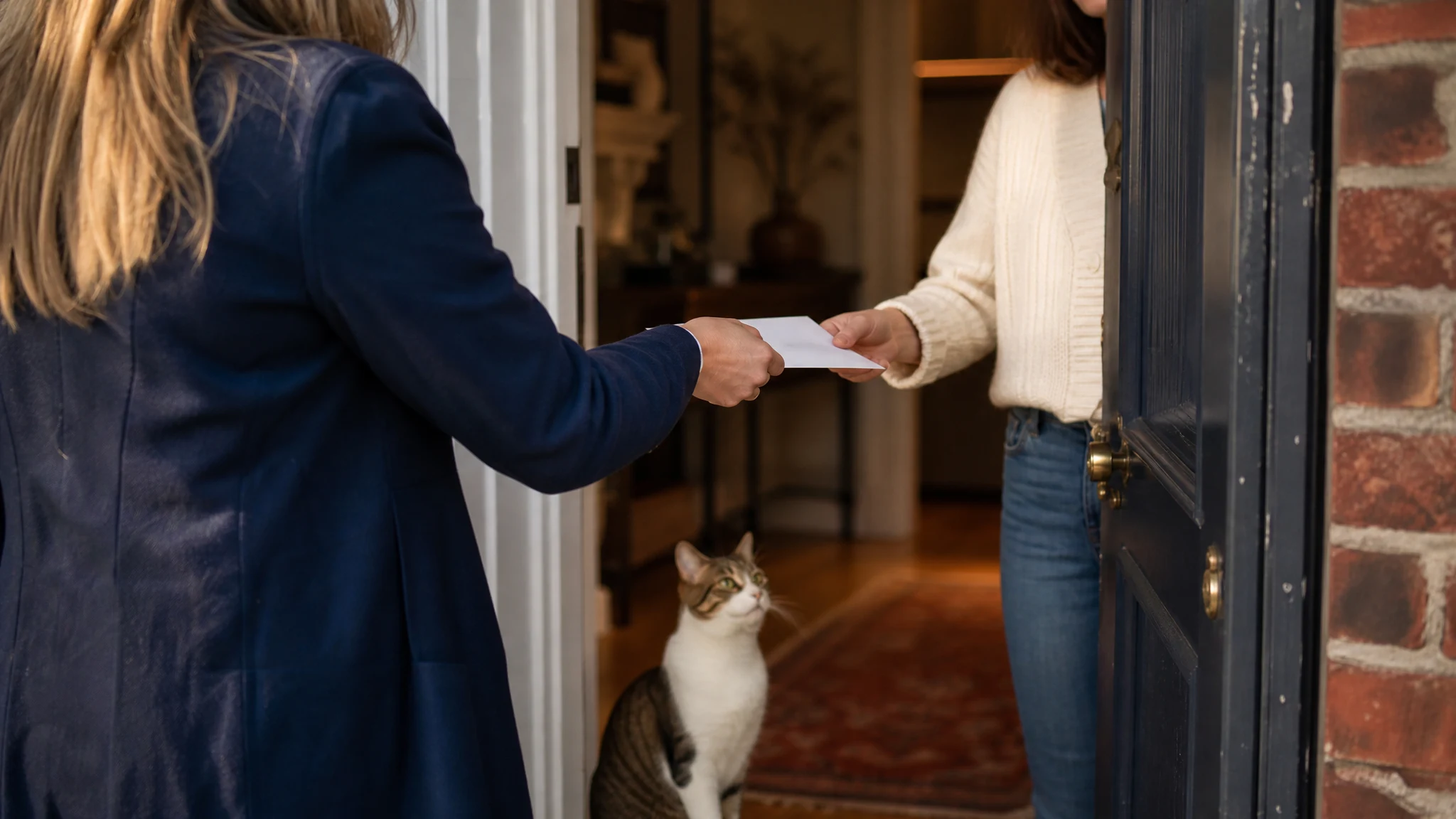
What a Landlord Can Ask About Your Emotional Support Cat
Few moments in the rental process feel as exposing as the one in which a landlord asks about your emotional support cat. Federal law gives housing providers a narrow, well-defined set of questions they may ask, and a much longer list they may not. Knowing where that line sits lets you answer calmly, protect your privacy, and keep the conversation professional. This guide walks through the process step by step, from what to gather before you submit a request to how verification works in practice, including how Florida landlords verify an ESA letter and what a Texas landlord may check. The principles apply in every U.S. state.
The Legal Framework in Brief
The federal Fair Housing Act treats an emotional support animal as a reasonable accommodation for a person with a disability, not as a pet. HUD's notice FHEO-2020-01, Assessing a Person's Request to Have an Animal as a Reasonable Accommodation Under the Fair Housing Act, is the federal authority that explains how housing providers should evaluate these requests. For a fuller treatment of the underlying protections, see our guide to emotional support cat housing rights under the Fair Housing Act.
Under that guidance, a landlord may ask for reliable documentation when the disability or the disability-related need for the animal is not readily apparent. That is the whole of the permitted inquiry. It is not an invitation to review your medical history.
Materials You Will Need
- A current ESA letter from a licensed mental health professional (LMHP) who is licensed in your state, such as an LCSW, LMHC, LMFT, psychologist, psychiatrist, or a licensed primary-care provider where state law permits.
- A written accommodation request addressed to the landlord or property manager, dated, and kept as a copy for your records.
- Basic information about your cat, such as name, general description, and veterinary vaccination records if your lease or local rules ask for them.
- Your lease and any pet policy, so you understand what the property's standard rules say.
- A record of all communications, preferably email, with dates.
If you do not yet have a letter, our walkthrough on how to get an ESA letter for your cat explains what to expect from a clinician evaluation. A licensed clinician will determine whether an emotional support cat is therapeutically appropriate for you; approval is never automatic.
Step 1: Understand What a Landlord May Ask
A housing provider may generally ask for documentation that establishes two things: that you have a disability as the Fair Housing Act defines it, and that the cat provides support related to that disability. A letter from a licensed professional who has personal knowledge of your situation is typically the reliable documentation HUD describes.
A landlord may also reasonably ask whether the request is genuine, by looking at the letter itself: the clinician's name, license type, license state, and signature, the date, and a statement connecting the animal to your needs. Some landlords will contact the clinician's office to confirm that the letter is authentic. That is verification of the letter, not a review of your treatment.
Step 2: Know What a Landlord May Not Ask
Federal guidance is equally clear about the limits. A landlord generally may not:
- Ask for your diagnosis, medical records, or details of your treatment.
- Require you to use a particular form, or demand a notarized statement.
- Require a specific cat registry, ID card, vest, or training credential.
- Charge a pet deposit or pet rent for an approved assistance animal.
- Apply breed, size, or weight limits to your accommodation request.
- Ask you to demonstrate the cat's "tricks" or prove it has task training. An emotional support cat is not required to be trained.
A landlord can still hold you responsible for actual damage, and may deny a specific animal that poses a direct threat to others or would cause substantial physical damage that cannot be reduced by other means. Such decisions are meant to rest on the individual animal's conduct, not on assumptions about cats in general.
Step 3: Submit a Clear Written Request
Keep the request short, courteous, and factual. State that you are requesting a reasonable accommodation under the Fair Housing Act to live with your emotional support cat, attach the letter, and ask the landlord to confirm in writing. You do not need to explain your condition. Send it by email or another method that leaves a dated record, and keep a copy.
Step 4: Be Ready for Verification
Verification is where most of the friction arises, and it is usually resolved when the letter is complete. Before you submit, read the letter as a landlord would. Confirm that it is on the clinician's letterhead, that the license type and number and the state of licensure are present, that it is signed and recently dated, and that it states the clinician's professional relationship to you.
How Florida Landlords Verify an ESA Letter
Florida is the state where verification is most structured. Florida Statute 760.27 addresses emotional support animal requests in housing and is explicit about who may support them. A Florida landlord may request reliable documentation, and the clinician providing it must be licensed in Florida or must have an established, prior in-person relationship with you. Online-only providers who are not licensed in Florida cannot issue a valid Florida ESA letter.
In practice, a Florida landlord verifying an ESA letter will typically look for these elements:
- The clinician's Florida license type and number, which can be checked through the state's public license lookup.
- Evidence that the clinician has personal knowledge of your disability-related need.
- A signature and date, with the clinician's contact information.
The statute also addresses misrepresentation: knowingly giving false information to obtain an accommodation can carry consequences, which is one more reason to work only with a properly licensed clinician. For landlord disputes in Florida, consult a Florida-licensed attorney.
How a Texas Landlord Verifies an ESA Letter
Texas follows the federal framework through the Texas Fair Housing Act, found in Chapter 301 of the Texas Property Code, which tracks the federal Fair Housing Act. A Texas landlord verifying an ESA letter will generally apply the same HUD guidance: reliable documentation from a licensed professional where the need is not obvious, with no entitlement to your records or diagnosis. As in every state, the most dependable letter comes from a clinician licensed in Texas, because a landlord who checks the license will find it in order. If a dispute develops, a Texas-licensed attorney or your local legal aid office can advise you.
States With a 30-Day Relationship Requirement
California (AB-468), Montana (HB-703), Arkansas, Iowa, and Louisiana require by state law a minimum 30-day established therapeutic relationship between you and the clinician before an ESA letter can be issued. Letters from those states reflect that waiting period by design, and we frame it as a feature: it means the letter complies with your state's law and is more likely to hold up to scrutiny. Start early if you live in one of these states and a lease deadline is approaching.
Step 5: Handle the Registration Question Correctly
Landlords sometimes ask whether your cat is "registered," and tenants sometimes assume a registry number will settle the matter. It will not. Registration, an ID card, or a certificate is not a legal requirement, and housing rights under the Fair Housing Act come only from a letter written by a licensed mental health professional. A landlord is under no obligation to accept a registration number or ID card in place of the letter, and you should not present one as if it were.
ESA Cat offers an optional registration service, and some owners value it for practical reasons. The foremost is lost-pet recovery: a database entry and ID tag can help reunite you with your cat if it slips out of a new building. It also includes lifetime registration, an ID card and certificate for your own records, and a discount on the ESA letter. Treat it as a convenience, never as a substitute for the letter. Be wary of generic online services that sell a $40 "certificate" and imply it carries legal weight; it does not.
Step 6: Respond to Questions Without Over-Sharing
If a landlord asks something that falls outside the permitted inquiry, you can decline politely and redirect to the letter. A response such as, "My clinician's letter provides the documentation the Fair Housing Act contemplates; I'm happy to have you confirm its authenticity with their office," keeps things cooperative. Avoid arguing, and avoid offering medical details that no one is entitled to receive.
Tips for a Smooth Process
- Ask early. Submit the request before you sign the lease or as soon as you are considering a move, not after a complaint.
- Keep it in writing. Verbal agreements are hard to prove later.
- Be a good neighbor. Keep the litter box clean, manage odor and noise, and repair any damage promptly.
- Track renewals. Some landlords reasonably ask for a reasonably current letter, so keep yours up to date.
- Use your state's licensed clinicians. A letter from someone not licensed in your state is the most common reason verification fails.
Common Mistakes to Avoid
- Relying on a registry or certificate alone. It does not substitute for a clinician's letter.
- Buying from an unlicensed or out-of-state provider. This is especially risky in Florida, where Statute 760.27 requires a Florida-licensed clinician or a prior in-person relationship.
- Handing over medical records. The landlord is entitled to documentation of the need, not your file.
- Expecting air-travel rights. Since the Department of Transportation's 2021 rule change, airlines treat emotional support animals as ordinary pets, and the letter does not provide travel protections.
- Waiting until a dispute arises. Early, courteous communication prevents most problems.
What to Expect
Many tenants who submit a complete letter from a properly licensed clinician find that the landlord's review is brief and routine. A landlord may confirm the clinician's license, may ask a clarifying question, and may then grant the accommodation. Outcomes vary by property, by state, and by individual circumstances, and no letter can guarantee a particular result. If a request is denied or conditions are imposed that seem inconsistent with HUD guidance, you can respond in writing, ask the landlord to explain the basis, and seek help from a licensed attorney, your local legal aid office, or a fair housing organization. Complaints may also be filed with HUD.
Important Disclaimer
This article is informational content only. It is not medical, mental-health, or legal advice, and reading it does not create a clinician-patient or attorney-client relationship. Whether an emotional support animal is appropriate for you is a determination that only a licensed mental health professional can make after an individual evaluation. Please consult a licensed clinician in your state, and review your state's specific rules, including any waiting-period or licensure requirements. For disputes with a landlord, consult an attorney licensed in your state or contact your local legal aid office for help with Fair Housing Act enforcement.
Ready to start your ESA letter?
Licensed clinician review. Compliant with state law.
Get My ESA Cat Letter